Authentic Reproductive Justice

“Reproductive Justice.”

“Reproductive justice” is generally code for “abortion on demand and without apology.”  I propose we talk about “authentic reproductive justice,”  which means justice for the child.

Justice for children means that every child conceived has a right to be welcomed into life. The financial condition or age or belief systems of their parents are irrelevant. Equality for children means every child is treated the same from conception until birth: cared for by their parents, and welcomed into life.

Real Social Justice Warriors

The shallow concept of “Reproductive Justice” that we have currently enshrined in our laws cannot last for even a single generation. Sure, men and women may be more equal in education and income. But, children whose parents get married and stay married have immeasureable advantages over children whose parents divorce or never marry. The differences among the rich and the poor, the educated and the less educated, increase in the subsequent generation.

Equality and justice for children means that every child has a right to a relationship with both of their natural parents, unless some unavoidable tragedy prevents it.  Death, mental illness, serious illness, these tragedies separate children from their parents. Desertion, abuse, incarceration: the parent left behind may have no responsible choice other than keeping their children away from their other parent.

No-fault divorce: a structural injustice to the child.

“I don’t want to have a relationship with your other parent.”

“My relationship with my new sex partner is more important to me than my relationship with your other parent.”

“My new life and vision of myself is more important to me than my relationship with you.”

These are not unavoidable tragedies. These are acts of injustice by one parent perpetrated on their children and their spouse.

But you may ask, what do these have to do with “reproductive justice?” The concept of Authentic Reproductive Justice means that each parent commits to spending a lifetime in a relationship with the other parent that allows their child to have a functioning, supportive relationship with both of them.

That means:

  • treating the child’s other parent with respect: after all, the other parent is half of who your child is. If you disrespect the child’s other parent, you are disrepecting at least half of your child.
  • making sure your child can spend time with his or her other parent.
  • giving the child’s other parent significant input into all major decisions regarding the child’s life and upbringing.
  • supporting, not undermining the other parent’s authority and status in the child’s eyes.
  • having such a relationship with the other parent before even giving birth.
  • choosing the other parent carefully enough that spending a lifetime co-parenting is an imaginable and even joyful prospect.
  • and since all forms of contraception sometimes fail, only choosing to have sex with individuals whom you can treat according to the above criteria.

Authentic Reproductive Justice: Take your marriage seriously.

In other words, Authentic Reproductive Justice, which takes account of the human rights of the mother, the father and the child means:

  • get married
  • stay married
  • have sex only with your spouse
  • love your spouse

Our current understanding of “reproductive justice” that only considers “equality” between men and women, or “equality” in education, jobs and money is a superficial, dim shadow of Authentic Reproductive Justice. This is a technocratic vision, focused solely on material things.

Authentic Reproductive Justice focuses on the more humane, deeper realities of relationships, identity and love.

I can only think of one social philosophy that endorses this deeper concept of justice, and that provides the tools to bring it about: the Ancient Teachings of Christianity. One man, one woman, for life.  If you are a Christian, especially if you are a Catholic Christian, please respect what Jesus is trying to do for us. Embrace it. Live it. Be grateful for it. Matthew 19. Mark 10.

Should a Catholic divorcee date without an annulment?

I encountered a bit of controversy yesterday in a Facebook discussion. Please help me sort this out.

Pretend you are a divorced person, who is seeking an annulment. By chance, you connect with an old flame from high school. Please read the following passage, and see if it helps you discern whether you should start dating before the annulment comes through. Remember: try to put yourself in this person’s shoes, AND try to base your answer solely on what you read in this text.

When I met my husband, Bob, we had to wait for his Catholic Church annulment to go through before we could even date or plan a marriage. We went a year or so spending time as friends,  “brother and sister,”  mostly phone calls and a few visits with his parish priest. I was in Southern California and he was five hundred miles away in the San Francisco Bay area.  Occasionally we took turns driving back and forth to visit and, I admit, both of us were very physically attracted to the other.  We’d been high school sweethearts forty years prior and had met again at our reunion.  Because we’d been young and innocent together and grew up in the sixties, it was easy for us to feel somewhat like real brother and sister. Still, I remembered his kisses and those first, sweet stirrings of sexual desire from decades ago. We could not wait to make love. But we wanted to take the high road even more.

We could have moved past friendship, started dating, or moved in like so many do and started living as husband and wife but that would have been a lie. We discussed, argued, and finally agreed that we wanted something different than what the culture (and even some in the Church) told us we could do: we wanted to reserve sex for the true expression of a complete and total self-giving. In studying St. John Paul II’s Love and Responsibility we understood that it would be a lie to act out a full self-giving with our bodies before it had been exchanged in every other area of our lives.  We also knew that masturbation wasn’t an easy replacement; that, too, was a practice in self-centeredness (not self-giving) that can never foster authentic love. We agreed to take the high road.

So, what do you think, readers? To date, or not to date: that is the question.

The Tyranny of Lawlessness

The Amoris Laetitia crisis in the Catholic Church has many facets and unanswered questions. One question is: why are so few bishops and cardinals asking for clarification of the ambiguities in the document? Why are so few coming to the defense of the plain teaching of Jesus?

ignatius_of_loyola_militant
Ignatius of Loyola, former soldier, originator of the “servile” theory of obedience.
Over at Rorate Caeli,  John R. T. Lamont, DPhil offers a possible answer: too many Catholics have accepted a servile concept of obedience to authority.
The explanation lies in a false conception of religious authority, which considers it to be above the law rather than subject to law, and that sees the surrender of intellect and will to the religious superior as virtuous and indeed obligatory. This conception has deep roots in the history of the Church.

His argument is long and complex and I will not attempt to review it all here. But his bottom line is very much to the point of this blog.

This programme (of Pope Francis and his allies) does not intend to allow any divorced and remarried Catholics whatsoever to receive communion. Instead, it decrees that reception of communion is to be subject to the decision of the priest who gives it – a decision that is to be guided by considerations that are general enough to make the will of the priest in practice the determining factor. (my emphasis.) 

The programme is presented to the public as an increase in freedom for the divorced and civilly remarried. They will no longer be inconvenienced by having to get an annulment. Many of them will not go through the “process” of “accompanying” and simply give themselves permission to go to communion. (Let’s face it: many of them already are.) And since Amoris Laetitia does not actually establish a new process that defines “accompaniment and discernment,” it is easy to see why they would feel ok about giving themselves permission.
Oon the other hand, if a divorced and civilly remarried Catholic presents himself or herself to the priest in good faith, asking for “accompaniment and discernment,” there is no process or criteria in place to determine whether they can receive communion. This is when Dr. Lamont’s point kicks in with a vengance:
This replaces the divine law concerning marriage and the Eucharist with the authority of the priest, and enshrines the superiority of this lawless and therefore tyrannical authority over the authority of God Himself.

The priest decides, with no reference to any authority outside of himself.

divorce-decree-500-x-250
It looks so neat and tidy.

This is exactly comparable to the havoc that “no-fault” divorce created in American civil marriage and divorce law. Presented to the public as an increase in freedom for couples in “loveless” or “dead” marriages, the reality has been quite different. One party can divorce the other unilaterally, against the wishes of the other spouse. Quite often, the adulterous spouse seeks the divorce, and the law assists them.

No fault was presented to the public as a solution to the problem of legalistic, proceedings requiring one party to prove that the other was having an affair. The advocates of this far-reaching legal change did not seem to realize that these “sham” proceedings could only work if both parties agreed to make it work. The partners in the “dead” “loveless” marriage had to cooperate to make the court believe that one had met the legal criteria for a “cause” for divorce. The “loveless” partners had to agree to most of the terms going into the court, or they would not cooperate with each other.  Under the no fault regime, no one has to provide evidence of anything. One party can end the marriage against the explicit wishes of the other.

Family courts have become sources of tyranny in our culture, where the most powerful, the most vengeful, the richer systematically prevail over the weaker, gentler and poorer. Where the faithful spouse is at a disadvantage. God forbid the Church should replicate this form of “progress.”

But Dr. Lamont’s insight suggests that this is exactly what will happen. Under the interpretation of Church law inspired by Amoris Laetitia, the priest will have more, not less authority, because he will no longer feel himself bound by the annulment process defined by canon law. The more lawless divorced and civilly remarried spouses will give themselves permission. Those who most wish to follow Christ, will become the weaker parties, disadvantaged by the dismantling of legal processes.

french-women-rioting-for-bread
French women rioting for bread, during the Revolution

Looking across history and cultures, one can see this pattern: Lawlessness benefits the already strong, and harms the weak. The alternative to law is not freedom, but the Law of the Strongest.

“Nobody told me it was wrong”

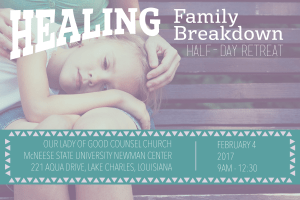
healing-family-retreat_postcard_front
Postcard, describing our most recent Retreat.

The Ruth Institute held another Healing Family Breakdown Retreat this past weekend. As I listen to people share their stories of family breakdown, a procession of past encounters marches through my memory. People tell me their stories, and not just at times appointed for this purpose, like the Retreat. I recall:

  • a college student in tears at our student conference: “Dr. Morse, you are the first adult I have ever heard say that divorce is hard on children.”
  • a middle-aged man whom I met at a party. He later told me that his mother (who had been married and divorced multiple times) recently revealed to him that she had had an abortion when he was in high school. The man was in shock over the loss of a sibling.
  • a woman in her sixties ran out of my talk at a conference. At the dinner that evening, she shared with me, that my talk stirred up the pain of her parents’ divorce.
  • a man who has been married and divorced twice, confided that he and his former wife had a child through IVF. The child is now a teenager. He has agonized for years over what to do with the 10 “leftover” frozen embryos. He would have to get the consent of his former wife, the mother of the embryos, for anything he might want to do. “When you are trying so hard to have a baby, they don’t tell you that you may end up killing babies.”
  • a couple on their second marriage, who had both chosen to sterilize themselves during their first marriages. Both were in tears, because they now wanted children with each other. They were Catholic and finally realized that the Church teachese that deliberate sterilization is sinful. “No one told me it was wrong,” they each said through their tears.

And that, for me, is the bottom line: no one tells people the down-sides of any aspect of our Brave New World. “No one told me it was wrong.”

Memo to priests and catechists: You are not hurting people to tell them “it is wrong.” You may be saving them from tremendous heart-ache. And incidently, you are doing your job.

Jesus was right, and we can prove it.

Jesus made His position on divorce very clear:  One to a customer for life. (Slight paraphrase.)

Seriously. His apostles were quite frankly, freaked out. He doubled down, and started talking to them about celibacy. Seriously. Look it up in Matthew 19. 

With the benefit of 2000 years of hindsight, we can see the wisdom of prohibiting attempts at second marriages. Divided loyalties for children. Broken hearts of abandoned spouses. Since we have been systematically breaking His commandments for the past 50 years, we have statistical evidence that divorce is hard on children.

sad-girlgrey-her-scars-are-on-the-insideThis particular research summary finds that children of divorce have poorer relationships with not only mother and father, but often with grandparents as well. Children of divorce have a weakened ability to handle conflict, are more likely to be aggressive, and as adults, tend to be less able to communicate effectively with their own spouses. Children of divorce have more behavior problems in school, more depression and anxiety, diminished learning capacity and lowered school performance. Child abuse and neglect are more common, especially in stepfamilies. Children of divorce have lifelong increased health burdens, including a risk of premature death. This summary of research goes on in this vein for 48 closely-typed pages, and 333 footnotes.

agony-in-the-garden
A classic image of the Agony in the Garden, the night before Jesus’ crucifixion.

On the night before He died, Jesus foresaw His own physical suffering as He prayed in the Garden of Gethsemane. I imagine that He saw all the sins of the world, for which He would suffer and atone. Because He was God, He could see all things and know all things. I believe He saw the children of divorce, weeping for the loss of the lives they had known. I believe He saw the anguish of abandoned spouses. I bet He saw the fact that second “marriages” are more likely to fail that first marriages. He saw the disappointment so many attempted second marriages would bring. He was trying to spare us all this.

archbishop-charles-scicluna-of-malta
Archbishop Charles Scicluna of Malta: What is he thinking?

Some bishops of the Catholic Church are interpreting Pope Francis’ Apostolic Exhortation, Amoris Laetitia to mean that divorced and civilly remarried Catholics can present themselves for communion, if they believe they are “at peace with God.” I cannot imagine what these men are thinking.

I can tell you what they are NOT thinking. They are not thinking about the abandoned spouses. They are NOT thinking about the children, whose families have been turned upside down by their parents’ switching out of parent-figures and sex-partners.

This is the child’s perspective. We tell them, “I still love you. But my relationship with my new sex partner is more important to me than my relationship with your other parent, even though your other parent is half of who you are.” The children cannot make sense of these incompatible claims.

Needless to say: this conflict does not even arise in families where the parents are continuously and faithfully married to each other.

There is, in the end, only one cure for this kind of social confusion. To say as often and as loudly as we can: Jesus was right to prohibit attempts at second marriages while the first spouse is still living. We know this from experience. Our experience is so profound, we will not be talked out of it.

If you have such an experience to share, please consider telling your story for the Tell Ruth the Truth blog. You will be helping more people than you know.

Help for Annulments, both for and against

I have had several posts about the Catholic controversies over divorce and remarriage. Here, here and here. This seems a good time to refer my friends and readers to resources that may be helpful to you.

If you are a Catholic, and believe your attempted marriage was not in fact a valid marriage, Rose Sweet’s material can help you through the annulment process. (Actually, Rose’s stuff helps a lot of people through alot of post-divorce healing.)

bai-macfarlane
Bai Macfarlane, foundress of Mary’s Advocates

If you are Catholic, and your spouse wants a divorce, and you believe your marriage is valid, Mary’s Advocates has a wealth of material for you. Bai Macfarlane has done a prodigious amount of labor, compiling information about canon law and Church teaching. She includes a sample petition for you to use to your bishop to ask him to try to intervene to stop a break-up.  Mary’s Advocates provides a template petition containing this plea. I do not know what your bishop will do or say. I do believe however, that no harm can come from asking.children-and-divorce

The Ruth Institute, the organization I founded, has a whole page for the Reluctantly Divorced (a term we coined) and a page for the Children of Divorce. We even created a brochure, summarizing the elevated risks that children of divorce face over their lifetimes.


Finally, you may wish to consider sharing your story with our readers. Ourruth-carousel-tell-your-story Tell Ruth the Truth blog provides an outlet for you, and solidarity for others in similar situations. I find that many people feel alone when they are dealing with family breakdown. Nothing could be further from the truth. You are absolutely not alone. Pretty much every family in America has some form of family breakdown, somewhere in their family tree. Let’s help each other.

Your friend,

Dr. J

“A Case Study in Communion for the Divorced/Remarried”

Crux has a case study, creating a compelling story in which a pastor might permit a divorced and civilly remarried Catholic to recieve communion. I have only one thing to say about this case study.

The priest should encourage the woman to pursue an annulment.

According to the scenario:

She wanted to pursue getting an annulment, although it was almost impossible to get any information or help from her parish in El Salvador.

Wouldn’t this be a good place for her pastor in the US to be willing communion-in-the-handto accompany her? Shouldn’t the tribunal in the US use some discernment about the missing information?
True, she might not get the annulment. But the process itself has merit. It helps to reveal truths that might have remained hidden. It helps clarify the person’s reasons for wanting to return to full communion with the Church. It may also clarify that the person was more culpable than they had otherwise realized, thus allowing her the opportunity for repentance, conversion and closer union with Jesus.

The author presumes she would not get the annulment. This is by no means certain. If she can show immaturity and ignorance, and if her putative husband does not raise objections, she might very well obtain it. And BTW, in this story, the putative husband has disappearred. This is one of the features that supposedly makes for a compelling scenario for pastorally permitting communion.

Irma had no idea where Francisco might be. She didn’t really even know if he was still alive. She had no family in El Salvador. She had brought no church or legal documents with her when she came to the States.

Evidently, she must have divorced him in abstentia, if she really couldn’t find him, otherwise she would be a bigamist, even under civil law. But isn’t there a legal procedure for declaring a long-missing person to be presumed deceased? If the person meets the criteria of being presumed dead, what does canon law say about her ability to contract a valid Catholic marriage?

And, in most countries, it might even take a shorter period of time than the several years the hypothetical pastoral process described in the article seems to have taken.

All in all, this “case study” is not compelling. The hypothetical situation it describes could be handled by “discernment and accompaniment,” through the annulment process. Good. holy, faithful priests have been handling situations like this all along.  The pastor should not give the person permission to receive communion, without first pursuing the annulment process.

The injustice of judging your own case

In yesterday’s post, I noted that Austen Ivereigh’s defense of Amoris Laetitia laid out a detailed proposal for how a person in an irregular marital situation might be allowed to receive communion.

What Amoris says is that a pastor approved by his bishop should arrange for, in effect, a long retreat involving an amoris-laetitia-coverexamination of conscience, a facing-up to truth, a light-and-shadows discernment, applying the truths of Catholic doctrine on indissolubility and the Eucharist to this particular, unique, concrete situation.


As far as I know, Amoris Laetitia contains no proposal creating a procedure for using the so-called internal forum. Mr. Ivereigh is proposing something not required by Amoris Laetitia itself.

Anyhow, I thought the point of  seeking a new statement on marriage was that legalism is objectionable. A specific procedure for 1. invoking the need for the “internal forum” and 2. actually doing the discernment, amounts to a new round of “legalism.”

If there isn’t such a procedure, the person in question essentially becomes the judge in his or her own case. I decide that my situation, although objectively adulterous, does not really bar me from the sacraments. I am not accountable to anyone on earth for this judgment.

To go back to the “obvious” case that Ivereigh proposed, what is to stop the abusive, abandoning husband from discerning on his own authority that he may worthily receive communion? The idea that he must have a priest’s permission to enter into the discernment process and to agree about his worthiness, doesn’t really solve the problem. What is to stop him from finding a friendly priest who agrees with him? Without any canonical process or even guidelines, what guides the priest?

Nothing. Except the priest’s own sense of how Amoris Laetitia fits in with the overall tradition that came before it.

We cannot forgo pastoral or canonical procedures completely.  It simply cannot be done. We cannot escape this problem.

british-judge-w-wig
Judge Thyself.

It is also “obvious,” but seldom discussed, that the vast majority of civil divorces are acts of injustice toward the abandoned spouse and especially toward the children. Who is taking their part? Who is standing for the integrity of the bond? Shouldn’t the Church be more prepared to accompany the victims than the perpetrators? Who stands for compassion for the children whose lives have been turned upside down? How do they feel when they see their abusive, abandoning or adulterous father going to Mass and receiving communion? Does anyone care how they feel?

One might say that this goes on already, and I would not argue. One might say that this is the way the American church has been handling contraception since 1968. Again, I would not argue.

But these are scandalous situations, that have done great harm to jpii-familiaris-consortiothe Church, her witness and to the souls who have been deprived of the fullness of Catholic teaching.

These situations should be corrected, not replicated.

John Paul II’s treatment of these issues in Familiaris Consortio was clear and compassionate. This is the document, which in practice, ought to guide pastors. The quest for either mercy or justice with no procedures at all is a vain quest.


Dr. J's Blog

Because Kids Need Their Own Mothers and Fathers...

Discover WordPress

A daily selection of the best content published on WordPress, collected for you by humans who love to read.

The Daily Post

The Art and Craft of Blogging

WordPress.com News

The latest news on WordPress.com and the WordPress community.